
Two SMD flexible LED strip quotations can look similar while covering different products, test conditions and delivery scopes. A useful comparison starts with a shared specification and evidence for the differences that matter to the furniture design.
This guide helps cabinet and furniture manufacturers, engineering teams, buyers and supplier-quality teams compare technical configuration, validation, batch consistency and total project cost. It is a general RFQ framework, not a claim about an unnamed competitor or a particular quoted model.
Start with six questions before comparing unit prices
Six comparison dimensions
| Dimension | What to align | Evidence to request |
|---|---|---|
| Product identity | Type, voltage, dimensions and revision | Controlled specification and drawing |
| Materials and structure | Critical materials and permitted substitutions | Material requirements and change controls |
| Optical and electrical output | Comparable measurements and limits | Method, conditions and sample results |
| Validation | Tests relevant to the application | Plan, sample identity, criteria and results |
| Supply scope | Accessories, processing and packaging | Itemized quote and packing specification |
| Repeat supply | Batch control, changes and support | Traceability and agreed commercial terms |
1. Establish a common RFQ specification
“SMD flexible LED strip” identifies a broad product type. Quotations can still differ in LED package, density, circuit construction, colour requirements, cutting interval, lead configuration, adhesive and protection treatment. Match the intended furniture application and order quantity before judging a price difference.
Information to define in the RFQ
| Specification group | Items to define |
|---|---|
| Base product | SMD type, voltage, width, length, LED density, cut interval and CCT |
| Performance | Output, CRI, SDCM, power tolerance and stated measurement conditions |
| Installation | Profile or cover, cable route, lead length, connector and adhesive substrate |
| Acceptance | Inspection limits, required reports, sampling and approval responsibilities |
| Commercial basis | Quantity and unit, MOQ, lead time, currency, delivery term and payment terms |
Identify what the quoted price buys: a metre of strip, a reel, a cut-and-wired section or a complete cabinet kit. Record the revision and what is included at that unit. A bare-strip price and a prepared lighting-kit price become comparable only after the scope is aligned.
2. Review the technical configuration behind the appearance
LED package materials and identification
A typical wire-bonded SMD LED package combines a chip, die attachment, electrical interconnects, support structure and encapsulation; white LEDs also use a colour-conversion arrangement. These work as a package system. The construction of the selected LED should be confirmed rather than inferred from a generic diagram.
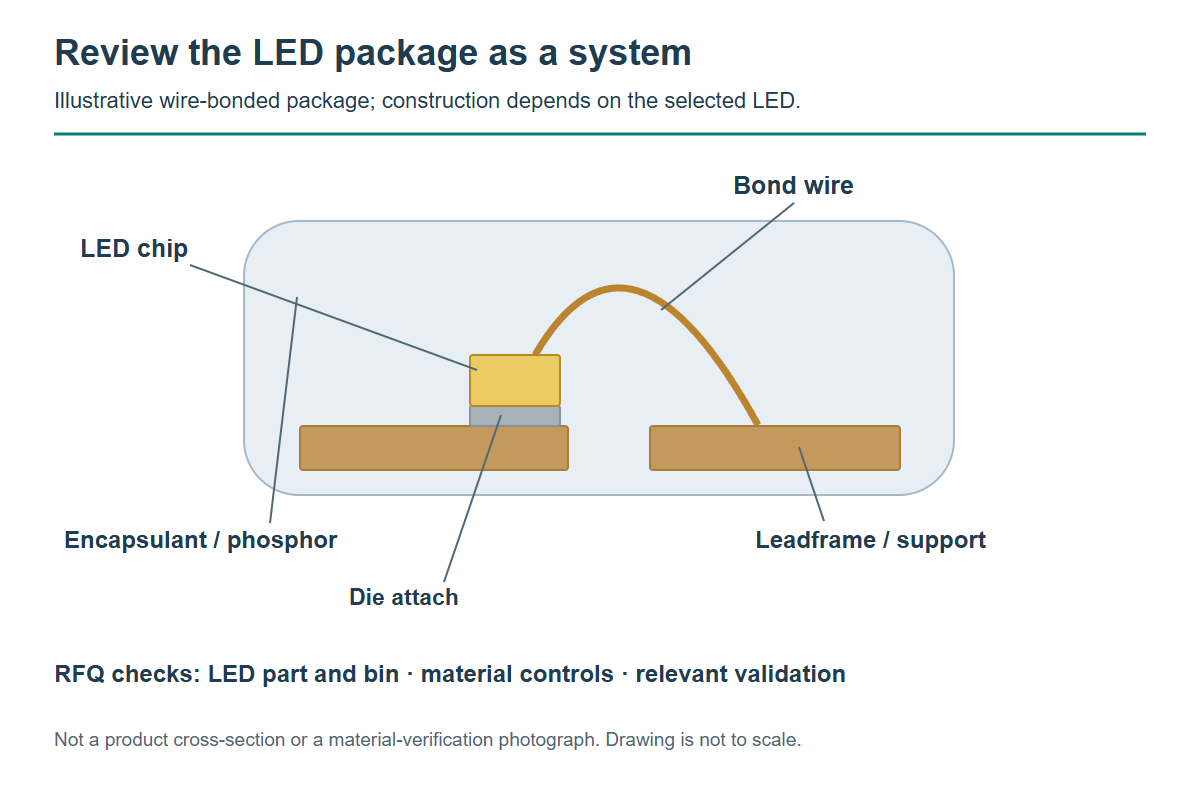
Illustrative wire-bonded SMD LED package. Chip, interconnect, support and encapsulation work together; this is not the internal drawing of a specified LED model. Select the diagram to view the full-size image.
Package details worth defining
| Item | What to establish | Limit of a simple label |
|---|---|---|
| LED identification and binning | Part or agreed performance range; colour-bin and mixing rules | A familiar LED brand does not by itself establish strip quality. |
| Bonding and die attachment | Specified materials, process controls and relevant validation | A wire name or visible colour does not establish lifetime. |
| Support and thermal path | Package structure and the application operating condition | A photograph does not measure thermal resistance. |
| Phosphor and encapsulation | Colour/output limits, consistency and material-change controls | A different formulation is not automatically better or worse. |
Suppliers may protect detailed formulations or a complete proprietary BOM. An RFQ can still define critical performance and material requirements, permitted substitutions, traceability and notification or approval before a change. Ask for evidence proportionate to the application and the information agreed for disclosure.
FPC layer count, copper and circuit design
Double-sided copper provides a different circuit construction from a single-sided board. The layer label alone does not establish lower voltage drop, acceptable temperature or a more durable finished strip. Copper thickness, conductor width, routing, feed length, load and installation all need to be considered.
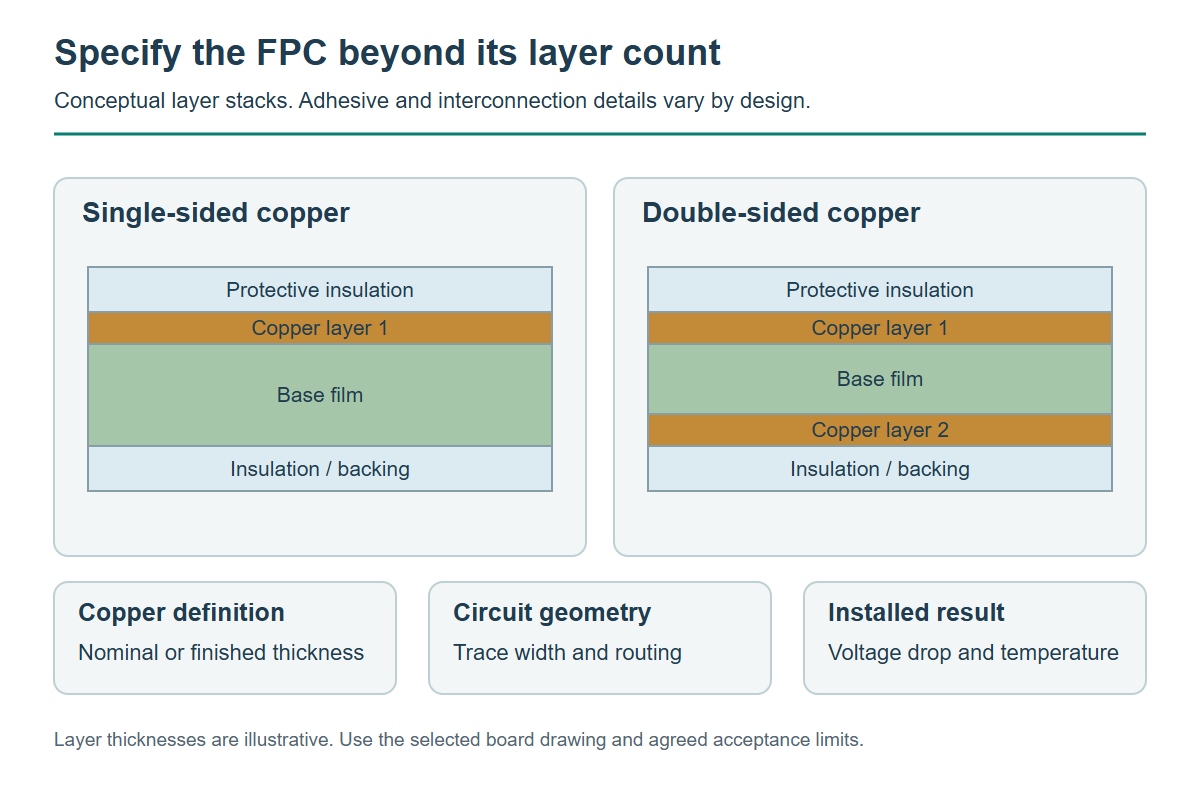
Conceptual single-sided and double-sided FPC copper structures. Layer count, copper definition, circuit geometry and installed electrical performance should be reviewed together. Select the diagram to view the full-size image.
FPC review fields
| Field | What to confirm |
|---|---|
| Copper construction | Single/double-sided definition and selected stack-up |
| Copper thickness | Starting or finished copper, unit and tolerance |
| Circuit geometry | Trace width, routing, pad design and feed length |
| Installed behaviour | Voltage drop and temperature rise at the intended load |
| Mechanical fit | Thickness, permitted bending and mounting method |
Clarify whether a copper value describes the starting foil or finished conductor, and whether both quotes use the same unit and tolerance. Check measured behaviour at a representative installed length. IPC guidance on flexible circuit constructions describes the distinction between single- and double-sided conductive constructions; the selected product drawing defines the actual stack-up.
Optical and electrical performance
A brightness number is useful only when its measurement basis is clear. Compare like assemblies under agreed conditions, including the supply, strip length, operating temperature and any cover or optical structure. CCT, colour rendering and chromaticity tolerance describe different requirements.
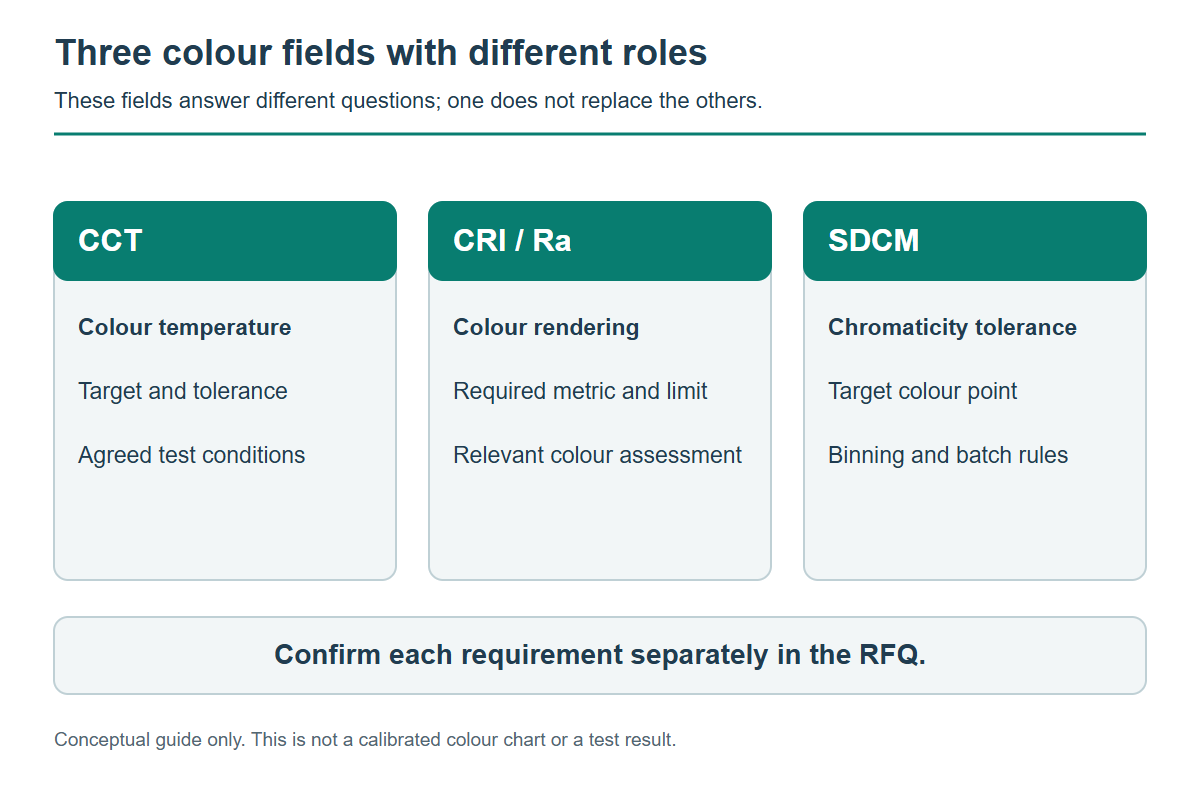
CCT, CRI and SDCM are separate RFQ fields. The illustration describes their roles rather than simulating measured colour or a product spectrum. Select the diagram to view the full-size image.
Performance fields and comparison conditions
| Field | What to align |
|---|---|
| CCT | Target colour temperature, tolerance and operating condition |
| CRI / Ra | Required metric and acceptance limit; special indices if needed |
| SDCM | Target chromaticity, binning and within-/between-batch acceptance |
| Flux and efficacy | Measured object, optical configuration, input-power measurement point and temperature |
| Power and current | Voltage, strip length, measurement location, stabilization and tolerance |
| Installed appearance | Profile/cover, viewing distance, target surface and uniformity/glare criteria |
For furniture lighting, review a sample in the intended profile and cabinet position. Diffusion, shielding, viewing distance and nearby surfaces affect the appearance seen by the user. A bare-strip result alone does not determine uniformity or glare in the final cabinet.
Adhesive, leads, connectors and customization
Write down the adhesive identity or agreed performance, width, target substrate and application/storage requirements. For leads, define length reference points, wire size, insulation, colour, exit direction and termination. Specify connector pairs, polarity, current requirements and quantities.
Custom cutting, soldering, sealing, labels and packaging may add material, setup, processing or inspection work. Confirm the supply boundary for each item instead of treating “with cable” or “with adhesive” as a complete specification.
3. Compare validation evidence against the actual risks
A test-machine list shows available capability. For an RFQ decision, request the tested model and revision, sample identity, method, conditions, duration, acceptance criteria and recorded result. Decide which tests are relevant to the furniture installation and target market.
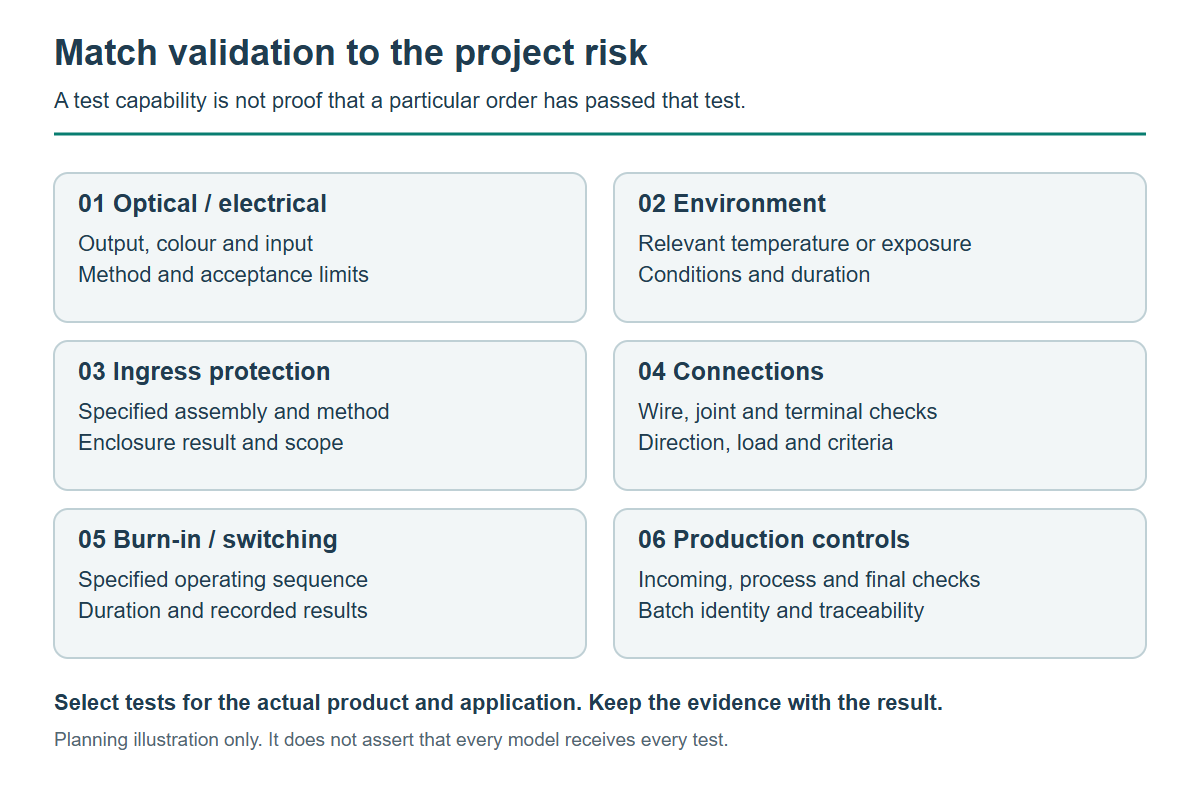
Validation planning framework: choose relevant tests, then record the sample, method, conditions, result and acceptance limits. This is not evidence that a product passed these tests. Select the diagram to view the full-size image.
Validation evidence to review
| Category | Main purpose | Evidence that makes it useful |
|---|---|---|
| Optical / electrical | Output, colour, power and electrical measurements | Method, stabilization, sample and acceptance limits |
| Burn-in / switching | Early abnormalities and specified operating stresses | Temperature, supply, load, duration, cycles and results |
| Environment / ingress | Relevant exposure and enclosure behaviour | Selected product assembly, method, conditions and scope |
| Mechanical / connections | Lead, joint and connector retention | Force direction, method, samples and pass/fail criteria |
| Safety / material compliance | Requirements applicable to the target product and market | Document type, product coverage and applicable standard edition |
Burn-in can help identify early abnormalities under its specified conditions. More hours do not automatically establish a longer service life. Even LED-component lumen-maintenance evidence alone does not establish the lifetime of a complete lighting assembly, as explained in the IES position on LED product lifetime. Keep production screening, reliability evaluation and lifetime claims distinct.
iPixel's Testing & Validation page describes project-based optical, electrical, environmental, ingress and connection testing capabilities. The agreed project plan determines the tests, samples and limits for an order; a capability page is not a test report for every listed product.
Check compliance documents by type and scope. A test report, certification, declaration of conformity and material declaration answer different questions. Match the model, configuration, issuing body, applicable edition and current status to the intended purchase. Do not extend one component's documentation to an entire cabinet system.
4. Check consistency across reels and repeat production
An approved sample is the reference for introduction, while production records show how later material and manufacturing lots are controlled. For adjacent cabinets or later replenishment, differences between reels or dates can matter as much as the appearance of the first sample.
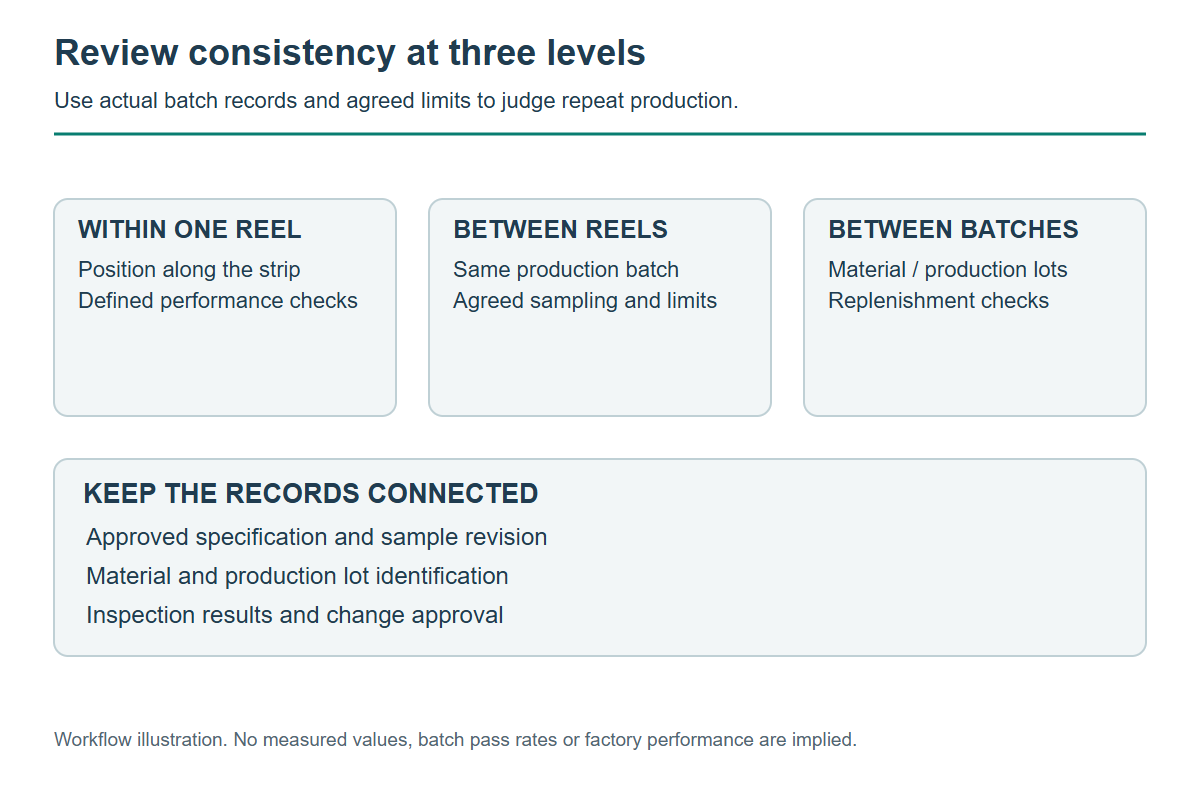
Within-reel, between-reel and between-batch consistency need linked specifications, material identification and inspection records. No synthetic measurement curve is presented. Select the diagram to view the full-size image.
Review three levels: variation along one reel, differences between reels in a batch, and changes between production or incoming-material batches. Define the relevant colour, light-output, power and appearance limits and how the samples are selected.
- Approved reference: retain the signed sample, drawing and specification revision used for the order.
- Material and bin controls: identify critical LED, FPC, adhesive, lead and connector requirements and the agreed binning rules.
- Traceability: connect material lots, production orders, inspection results and delivered labels.
- Change and abnormality handling: agree notification, approval, isolation, investigation and corrective-action requirements.
If a supplier provides SPC charts or Cp/Cpk figures, first examine the measured characteristic, limits, sample period, process stability, distribution and measurement suitability. NIST process capability guidance explains why capability measures depend on their underlying process and data assumptions. A single index is not a substitute for reviewing the batch records.
5. Compare the complete quotation and project cost
List separately what is included in the recurring price and what is charged once, priced as an option or excluded. Keep the delivery quantity, destination and commercial assumptions the same across the quotations.
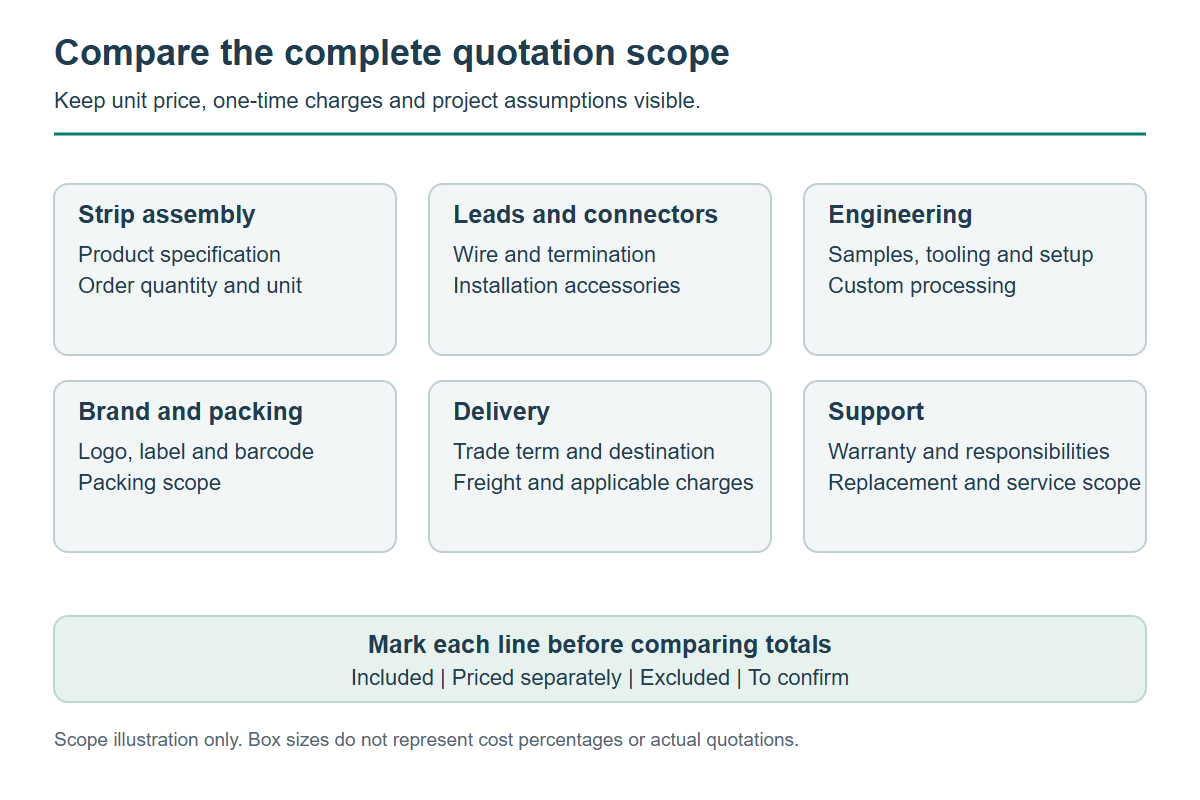
Quotation scope checklist covering the strip, accessories, engineering, branding, delivery and support. The categories do not imply fixed cost shares. Select the diagram to view the full-size image.
Scope items to make explicit
| Cost or responsibility group | What to check |
|---|---|
| One-time work | Engineering, samples, tooling, fixtures, artwork and validation |
| Strip and processing | Length cutting, leads, soldering, sealing and agreed inspection |
| Accessories | Connectors, end caps, adhesive, profiles and mounting parts |
| Brand and packing | Logo, labels, barcodes, instructions, reels, boxes and carton quantities |
| Delivery and terms | Quantity breaks, MOQ, lead time, currency, trade term and destination |
| Support and ownership | Warranty scope, failure analysis, replacement, freight and change notification |
Use four states consistently: Included, Priced separately, Excluded, To confirm. The ability to provide a service does not mean its cost is included. Clarify whether MOQ applies to the whole order or individually to each length, CCT or model.
Where the project involves installation or future service, compare those costs separately from the quoted purchase price. Use documented history or clearly stated assumptions for labour, rework, replacement, stock and obsolescence. Avoid a precise saving claim without data, and do not count the same charge twice.
6. Record the comparison in an evidence matrix
Use the matrix after real quotations arrive. Record the supplier response and its supporting document, revision or unresolved question. A missing response remains open rather than being treated as either a pass or a failure.
Supplier comparison worksheet
| Comparison field | Supplier A | Supplier B | Evidence or status |
|---|---|---|---|
| Specification and revision | Supplier response | Supplier response | Controlled specification / drawing |
| LED and FPC requirements | Supplier response | Supplier response | Material information / validation |
| Measured performance | Supplier response | Supplier response | Conditions, results and limits |
| Relevant validation | Supplier response | Supplier response | Plan / report and model coverage |
| Accessories and packing | Supplier response | Supplier response | Itemized scope / specification |
| Batch and change controls | Supplier response | Supplier response | Records / traceability / change terms |
| Delivery and support | Supplier response | Supplier response | Quote / agreed responsibilities |
| Comparable total | To calculate | To calculate | Same quantity, destination and scope |
Download the RFQ comparison worksheet (CSV). The blank worksheet includes technical, scope, evidence and repeat-order fields; it contains no invented supplier prices, ratings or test results.
7. Confirm the release basis again before a repeat order
- Specification: verify that the drawing, critical BOM requirements and approved sample revision remain valid.
- Changes: confirm any material, bin, process, location or substitute-part changes and the required approval.
- Batch requirements: agree within-reel, between-reel and replenishment acceptance and the handling of exceptions.
- Delivery and support: reconfirm lead-time changes, replacement or discontinuation arrangements, traceability and warranty responsibilities.
8. Frequently Asked Questions
Does a lower price prove that the strip uses inferior materials?
No. Price differences can reflect configuration, production efficiency, customization, inspection, delivery scope or commercial terms. Align those fields and request supporting evidence before making a quality judgment. A higher price also needs a clear technical or service basis.
What should buyers ask about LED chips and bond wires?
Ask for the agreed LED identification or performance range, critical material requirements, binning, change controls and relevant verification. Evaluate the package and operating conditions together. A material name alone does not determine finished-strip lifetime.
Does double-sided FPC automatically make a strip better?
No. It is a construction choice. Compare the copper definition, conductor geometry, electrical load, feed length and installed voltage-drop and temperature behaviour against the application requirements.
Does longer burn-in prove longer service life?
No. Confirm the screening or validation objective, conditions, duration, sample quantity and acceptance rules. Service-life claims need evidence appropriate to their scope.
Which testing or compliance documents should be requested?
Request documents relevant to the selected model, assembly and target market. Check their type, coverage, conditions, issuing party and applicable edition. The number of files alone is not evidence of suitability.
Why are batch controls needed after a sample passes?
The sample represents a defined item and condition. Repeat production also needs controls for incoming materials, colour bins, processes, inspection and approved changes so later orders can be compared with the agreed reference.
Why list leads, connectors, labels and packaging separately?
They may be included, separately priced, excluded or still undefined. Their details also affect factory assembly and logistics. Compare the same quantities and supply boundary rather than only the price per metre.
What information helps iPixel prepare a comparable OEM quotation?
Send the application drawing, dimensions, optical requirements, supply and control conditions, lead and connector requirements, expected quantities and target markets. Include the requested reports, packing scope and sample-approval process.
Discuss Your Furniture Lighting RFQ with iPixel
For applicable SMD flexible-strip configurations, iPixel's material approach includes gold-wire bonding and double-sided FPC, with burn-in and project-specific validation defined for the selected product. Confirm the configuration, test conditions and supporting documents in the quotation and approved specification.
Send your drawing and RFQ requirements to inquiry@ipixelleds.com for a coordinated review of the strip, accessories, validation and supply scope. The resulting quotation should identify the model, included items and unresolved requirements so your engineering and purchasing teams can evaluate the same configuration.