
Corners can make lighting integration difficult when an LED strip must follow a cabinet, screen frame or decorative panel. S-shaped LED strips support 90-degree bends, helping reduce cutting and reconnection at corners along suitable installation paths. Options include single-color, analog RGB/RGBW and addressable RGB/RGBW.
The right choice depends on the equipment outline, available space, supply voltage and control requirements. The gaming-machine and screen-surround applications below show how these factors work together.
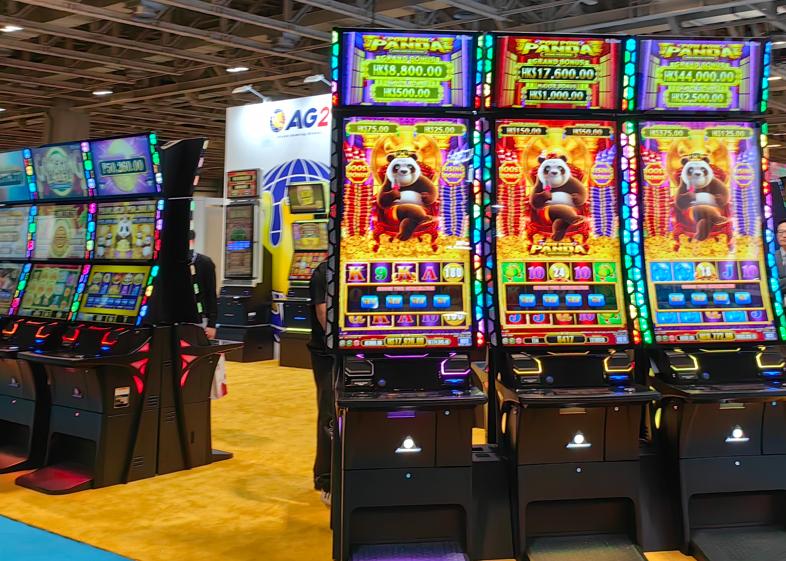
Application example: lighting around gaming-machine screens and decorative outlines.
1 Which installation paths suit an S-shaped strip
S-shaped strips suit backlighting paths with in-plane curves, corners and irregular outlines. The strip is typically concealed inside the equipment, with light passing through the equipment manufacturer’s cover, translucent panel or diffuser.
A path combining straight sections, rounded corners and 90-degree turns can be easier to follow with an S-shaped structure. A 90-degree bend does not mean a sharp, zero-radius crease. Shape the flexible connecting sections without pulling solder pads, pressing LEDs or forcing the strip into a twist.
2 When the S-shaped structure is useful
Consider an S-shaped strip when an ordinary flexible strip is difficult to route around lateral turns and you want to reduce cutting, soldering and jumper wires at those turns. It is particularly useful when the lighting path must follow the equipment housing.
For a straight path, an ordinary strip may be sufficient. For a fixed shape with specific mounting holes or component placement, a custom rigid LED board may be appropriate. Start with the mechanical layout and assembly method.
3 Comparing S-shaped strips neon flex and rigid boards
An S-shaped strip is a light source for integration. The visible result depends on LED spacing, the distance to the cover and the diffusion materials. Side-bending neon flex typically includes a diffusing enclosure and can suit a directly visible, continuous light line. Where the equipment already has its own cover, compare cross-section dimensions, available space and light mixing.
A custom rigid board suits a defined outline and mechanical mounting arrangement. An S-shaped flexible strip allows the installer to adjust the route within its installation limits. Evaluate each approach against the drawing and a physical sample.
4 Choosing single-color RGB RGBW or addressable lighting
Use single-color for white or fixed-color backlighting. Choose analog RGB for whole-strip color control, or analog RGBW when an independent white channel is also needed. Choose addressable RGB or RGBW for programmed pixel effects along the outline. Chases, gradients and other effects depend on the controller, program and system configuration.
| Model | Light type | Voltage | Width | LED/m | Pixel/m | Power/m | Cutting unit | Control |
|---|---|---|---|---|---|---|---|---|
| S006060BB1LZ(S) | White | 12V | 6mm | 60 | — | 4.8W | 50mm / 3 LED | — |
| S008060CB3PZ(S) | Analog RGB | 12V | 8mm | 60 | — | 12W | 50mm / 3 LED | PWM |
| S012048CB4PZ(S型) | Analog RGBW | 12V | 12mm | 48 | — | 15W | 62.5mm / 3 LED | PWM |
| S005048CA3SA1(S) | Pixel RGB | 5V | 5mm | 48 | 48 | 10W | 62.5mm / 3 LED | SPI / SK6812 |
| S008060CA3SA1(S) | Pixel RGB | 5V | 8mm | 60 | 60 | 12W | 50mm / 3 LED | SPI / SK6812 |
| S008060CA4SA1(S) | Pixel RGBW | 5V | 8mm | 60 | 60 | 13W | 50mm / 3 LED | SPI / SK6812 |
| S008060CB3SB7(S) | Pixel RGB | 12V | 8mm | 60 | 60 | 9W | 50mm / 3 LED | SPI / HC-2815 |
Nominal specifications. The versions listed are IP20 and require suitable protection within the equipment. The current confirmed cutting unit for S008060CB3SB7(S) is 50mm / 3 LEDs. Cutting units and individually controlled pixels are different specifications.
The four addressable models serve different requirements: S005048CA3SA1(S) offers a 5mm RGB board; S008060CA3SA1(S) offers 5V RGB with an 8mm board and 60 pixels/m; S008060CA4SA1(S) adds an independent white channel; and S008060CB3SB7(S) uses 12V power and HC-2815 control. Available white-CCT variants of an RGBW product do not make the selected W channel tunable white.
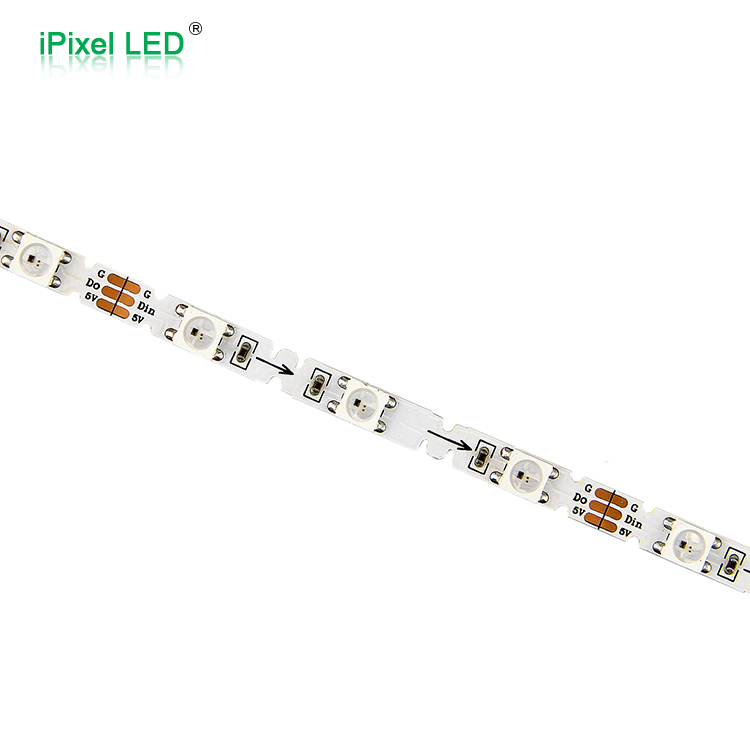
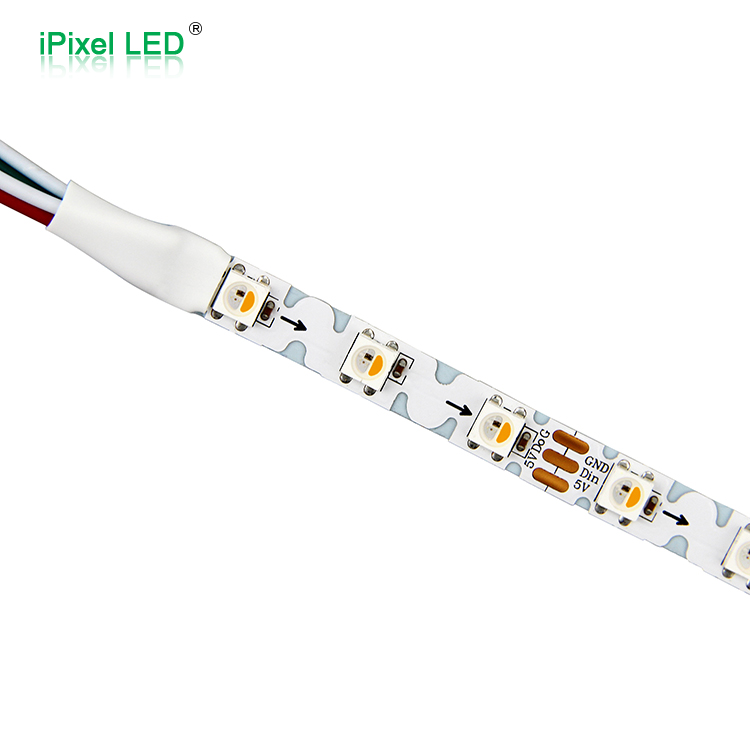
5mm pixel RGB: a candidate for width-constrained installation paths. Pixel RGBW: an independent white channel in addition to RGB.
5 Integrating the strip into equipment
Before installation, check the outline dimensions, available width, distance to the cover and maintenance access. The products have 3M adhesive backing for installation on a clean, suitable surface. Where additional retention is required, use an adhesive or fixing method compatible with the strip and substrate.
Use the rated voltage and the wiring diagram for the selected model. For addressable strips, check data direction, grounding and controller configuration. Never connect a 5V strip to a 12V supply. Determine continuous run length, wire size, power-injection points and thermal arrangements for the power load and equipment structure.
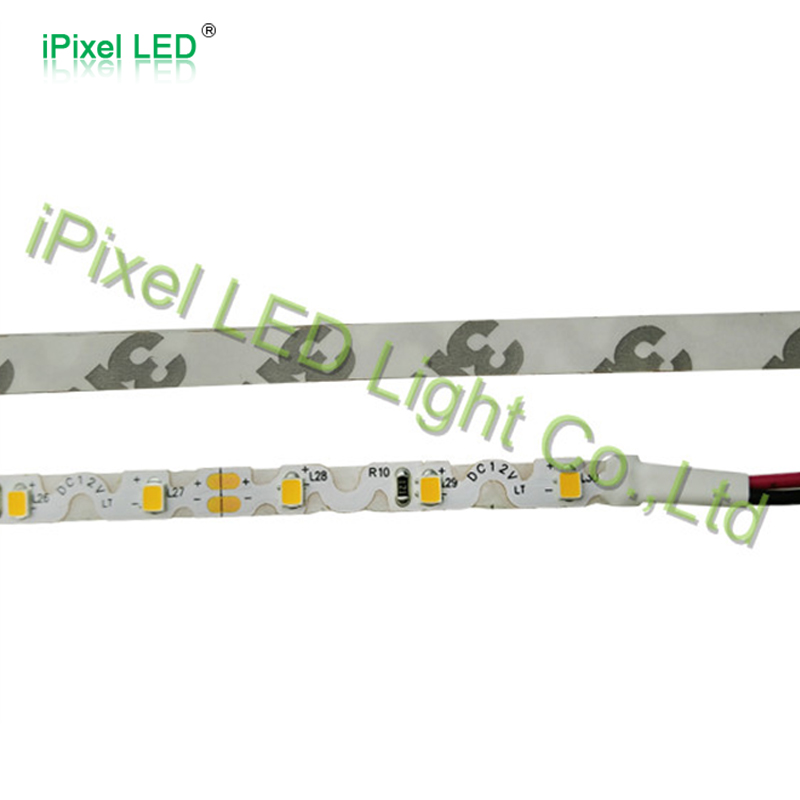
Adhesive backing assists positioning and fixing; suitability depends on the mounting surface.
6 Gaming-machine and screen-surround applications
In the gaming-machine and screen-surround applications shown, ease of routing around corners was a key reason for selecting S008060CB3SB7(S). The strip follows the equipment outline while providing addressable RGB lighting.
The integration task is to fit the housing and frame, then produce the desired ambient effect through the light-transmitting structure. Screen-surround lighting here means decorative illumination around the equipment frame, rather than backlighting inside an LCD panel.

Screen-surround application: coordinate corner geometry, frame width and the light-transmitting structure.
Pixel-strip series demonstration. Effects depend on the selected model, controller and program; the compilation is not a model-by-model specification.
7 Validate the design with data and samples
For white lighting, review CCT, color rendering and luminous flux. For RGB, check the individual color channels; for RGBW, review the W channel separately. A one-meter white sample of S006060BB1LZ(S) recorded 516.73lm, 4.738W and Ra93.4 in its test report. These figures describe that tested sample.
For the 5mm S005048CA3SA1(S), linear normalization of a 0.5m sample gives approximately 263.54lm/m and 9.822W/m under the reported mixed-color condition. These are normalized reference values, not measurements of a one-meter sample. Verify final brightness, uniformity and temperature rise inside the actual equipment assembly.
8 Send a drawing for a lighting assessment
Send the equipment outline or installation photos with:
- Straight sections, rounded corners, 90-degree turns, installation width and total length.
- Single-color, whole-strip color control or pixel effects, and whether independent white is required.
- Available supply voltage and any existing controller or interface.
- Cover, diffuser, substrate and operating environment.
- Sample quantity, estimated annual volume and customization requirements.
Match the lighting to your equipment outline
Share your drawing, desired effects and power requirements. iPixel LED can assess suitable models, installation arrangements and a sample proposal.Request an assessment inquiry@ipixelleds.com